• Home
  • About Journal
  • Editorial Board
  • Instruction
  • Journal Online
    • Just Accepted
    • Current Issue
    • Archive
    • Most Read Articles
    • Most Download Articles
    • Most Cited Articles
    • E-mail Alert
    • RSS
  • Publishing
  • Subscription
  • Contact Us
  • 中文
News
News
“‘两路’精神研究”专刊征稿启事
Previous Next

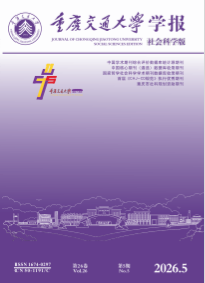
Journal of Chongqing Jiaotong University (Social Sciences Edition)
Bimonthly,Founded in 2001
ISSN:1674-0297
CN:50-1191/C

  
  • Current Issue
  • Just Accepted
  • Archive
  • Most Cited
18 October 2026, Volume 26 Issue 5
“Harmony” and “Difference”: The Fourfold Logic Between the Great Party-Building Spirit and the “Two Roads” Spirit
Zhang Dongwei,Zhang Xiaodi
2026, 26(5):  2-12. 
Asbtract ( )   PDF (1100KB) ( )   PDF(mobile) (1099KB) ( 0 )  
References | Related Articles | Metrics
The great Party-building spirit and the “two roads” spirit are both important components of the spiritual pedigree of the CPC. As the source of life of the spiritual pedigree of the CPC people, the great Party-building spirit is an important root of the spiritual pedigree. The “two roads” spirit, as an important branch of the spiritual lineage of the CPC members, has opened up branches and leaves for the diversified development of the spiritual lineage. The internal logic between the great Party-building spirit and the “two roads” spirit is deeply explored. And the analysis is made from four different dimensions, namely, source and flow, communication and difference, integration and living, and body and use. The interaction, relevance and comparative differences among the two are borrowed from a new perspective of all directions, multi angles and depth, with a view to provide more reference for further expanding the comparative research between the spiritual pedigrees of the CPC people in the future.
Research on the Path of Inheriting and Promoting the “Two Roads” Spirit Empowered by Digital Intelligence Technology
Xiang Lulin,Zhang Xiaoyue
2026, 26(5):  13-23. 
Asbtract ( )   PDF (1085KB) ( )   PDF(mobile) (1084KB) ( 2 )  
References | Related Articles | Metrics
Digital-intelligent technology offers dual opportunities for theoretical empowerment and practical transformation in inheriting and promoting the “two roads” spirit. Theoretically, following the logical chain of “resource digitization - scenario-based narration - precise communication - identity internalization”, digital-intelligent technology enables the permanent preservation, immersive reproduction, precise reach and value internalization of red spiritual resources, providing a systematic technical toolkit to address the contemporary limitations of traditional inheritance models. However, the current practice of promoting the “two roads” spirit still faces three major practical dilemmas: the absence of a multi-stakeholder coordination mechanism hinders the formation of joint inheritance forces; unbalanced spatial coverage leads to obvious shortcomings in urban-rural and regional communication; lagging carrier innovation and the lack of effect evaluation further restrict the in-depth realization of spiritual values. Therefore, innovative paths should achieve breakthroughs in four aspects: upgrading virtual simulation experiment technology to solve the problem of historical scene restoration; deepening the construction of a targeted digital-intelligent content system and strictly controlling creation quality; building a communication matrix featuring immersive experience, precise push and cross-platform collaboration; and improving a guarantee mechanism of policy support, resource integration and dynamic supervision to uphold the regulatory bottom line.
Symbols and Values: Promoting the Construction of the Chinese Ethnic Community through Cultural Symbols on the Qinghai-Xizang Highway
Liu Lu,Jia Wei
2026, 26(5):  24-34. 
Asbtract ( )   PDF (1085KB) ( )   PDF(mobile) (1084KB) ( 0 )  
References | Related Articles | Metrics
As a landmark project of transportation construction in ethnic minority areas of New China, the cultural symbol of the Qinghai-Xizang highway has deeply reflected the historical context of the construction of the Chinese national community. Based on relevant theories of semiotics, this paper systematically examines the formation background, connotation structure, and functional evolution of the cultural symbol of the Qinghai-Xizang highway, revealing its unique role in promoting ethnic exchanges and integration and strengthening the awareness of the Chinese national community. The research shows that the cultural symbol of the Qinghai-Xizang highway has been elevated from an infrastructure to a spiritual bond through the triple mechanism of “transportation empowerment - economic sharing - cultural identity”, and its development process confirms the essential characteristics of ethnic relations under the socialist system with Chinese characteristics, which are equality, unity, mutual assistance, and harmony. In the new era, the empowerment effect of the Qinghai-Xizang highway on the construction of the Chinese national community should be further released through continuous enrichment of the connotation of its cultural symbol, strengthening of ethnic spiritual identification, and continuous optimization of the economic structure to achieve shared economic interests among ethnic groups and enhance the sense of identity of all ethnic groups with the Chinese national community.
Research on the Effect of High-Speed Rail Network Affecting Entrepreneurial Activity in Cities Based on a Comparative Analysis of Prefecture-Level and County-Level Cities in China
Huang Chengfeng,Luo Jun,Li Xiao
2026, 26(5):  35-50. 
Asbtract ( )   PDF (1202KB) ( )   PDF(mobile) (1201KB) ( 2 )  
References | Related Articles | Metrics
How to improve the entrepreneurial vitality of the whole society and promote common prosperity by transport infrastructure construction is a realistic issue of concern for policy makers. Using data on newly established enterprises from 280 prefecture-level cities in China during 2004-2018 and 2703 county-level cities during 2000-2021, this study conducts an empirical analysis of the impact of high-speed rail (HSR) opening on urban entrepreneurial activity and its mechanism of action. It is found that HSR significantly increases the number of new enterprises in cities at both prefecture-level and county-level spatial scales, and the greater the frequency of HSR stops, the stronger the promotional effect. This conclusion remains valid after addressing endogeneity issues and conducting robustness tests. Meanwhile, the impact of HSR on urban entrepreneurial activity shows significant heterogeneous characteristics: HSR has no significant impact on manufacturing entrepreneurial activity in prefecture-level cities, but shows a significant facilitating effect at the county level; HSR raises entrepreneurial activity more in non-productive service industries; moreover, the impact of HSR on urban entrepreneurial activity is more obvious in eastern regions, metropolitan areas and large cities with higher economic development levels. Reducing financing costs, promoting knowledge spillover and enhancing innovation capacity are important channels through which HSR increases urban entrepreneurial activity.
The Generation Logic, Evolutionary Process, and Scientific Connotation of the Red Gene in Chinese Railways
Qiu Tiexin
2026, 26(5):  51-60. 
Asbtract ( )   PDF (1092KB) ( )   PDF(mobile) (1091KB) ( 2 )  
References | Related Articles | Metrics
The red gene of Chinese railways encapsulates a series of spiritual and cultural factors formed during the development of the railways under the leadership of the Communist Party of China—a process that has contributed to the nation’s journey from standing up and becoming prosperous to growing strong. By analyzing the living conditions and distinctive characteristics of railway workers in modern times, this study clarifies the process through which Marxism was integrated with the railway workforce and reveals the historical inevitability of infusing this red gene into China’s railway system. The evolution of the red gene in Chinese railways is delineated through four historical stages: commitment to revolution, assuming the pioneering role, driving reform and innovation, and strengthening the nation through railway development. This evolutionary path illustrates how Chinese railways, supported and guided by the red gene, have mirrored the history of national rejuvenation in miniature. It examines the scientific connotations of the red gene, demonstrating its rich manifestations across six dimensions: core values, character, attitude, spirit, representation, and orientation. The research aims to address the theoretical questions of how this red gene “was formed,” “is understood,” and “has evolved”.
Practical Value, Legal Predicament and Solution to Tolls on Highways by Government-repay Loans
Li Xingque
2026, 26(5):  61-73. 
Asbtract ( )   PDF (1096KB) ( )   PDF(mobile) (1095KB) ( 0 )  
References | Related Articles | Metrics
Against the backdrop of the “Regulations on the Administration of Toll Highways” being included in the national revision agenda, the improvement of the toll system on the highways by government-repay loans urgently needs to be responded to and alleviated from the legal perspective. Under the macro background of moving towards a strong transportation nation and the coordinated development and security of the “15th Five-Year Plan”, the toll system on the highways by government-repay loans has unique contemporary value in maintaining economic and financial security, promoting coordinated regional development and optimizing the efficiency of transportation resource allocation. However, this system is confronted with legal predicaments in practice, such as the lack of uniformity in the principles of the tolls on highways, the violation of current rules in the toll period, and the violation of due process in the toll procedures. To solve the above-mentioned problems and release the institutional effectiveness, a two-pronged principle for tolls on highways should be established. That is, the “user pays” principle should be applied to expressways by government-repay loans, and the “cost compensation” principle should be applied to ordinary highways by government-repay loans. The toll period on highways should be optimized, that is, by creating a “debt repayment period” and a “maintenance period” to set the toll years separately. The legitimacy of administrative procedures should be supplemented by clarifying the public participation mechanism for the “unified loan and unified repayment” decision-making and improving the information disclosure system for the transfer of charging rights and interests.
Research on the Development Dilemma and Optimization Path of Integrated Transportation in Adjacent Regions of the Yangtze River Delta
Zou Jun,Zhao Shuting
2026, 26(5):  74-84. 
Asbtract ( )   PDF (1083KB) ( )   PDF(mobile) (1082KB) ( 1 )  
References | Related Articles | Metrics
The transportation integration of the adjacent regions of the Yangtze River Delta is an important cornerstone of the high-quality development of the Yangtze River Delta integration. Since the integration of the Yangtze River Delta was elevated as a national strategy in 2018, significant progress has been made in infrastructure construction, public transportation and inter-provincial road connectivity in the adjacent regions of the Yangtze River Delta. However, there are still problems in the integration of inter-provincial adjacent areas, such as unbalanced development of rail transit, poor coordination across administrative regions and insufficient social capital investment. From the perspective of high-quality development of inter-provincial adjacent areas, this paper puts forward some relevant countermeasures and suggestions, such as promoting balanced economic development, promoting cross-administrative coordination and increasing social capital investment.
High-Speed Rail Construction, Digital Vitality and Enterprise Digital Transformation
Wang Chunyang,Liu Yini
2026, 26(5):  85-100. 
Asbtract ( )   PDF (1181KB) ( )   PDF(mobile) (1180KB) ( 0 )  
References | Related Articles | Metrics
Under the strategic background of “Digital China” and “Transportation Power”, it is of great significance to examine the impact of transportation network construction on the development of digital economy. Based on the panel data of A-share listed companies in Shanghai and Shenzhen from 2007 to 2020, this paper takes the opening of high-speed rail as a quasi-natural experiment and constructs a double difference model to examine the impact of high-speed rail on the digital transformation of enterprises and its mechanism. It is found that the opening of high-speed rail and the increase in the frequency of stops significantly promote the digital transformation of enterprises, and the conclusion remains robust through a series of robustness tests. It is further found that the construction of high-speed rail promotes the digital transformation of enterprises by accelerating the concentration of digital talents and improving digital innovation capabilities, and this facilitating effect is particularly prominent in state-owned enterprises, high-tech enterprises, technology-intensive industries, and regions with relatively low levels of new infrastructure development.
How Digital Economy Promotes Carbon Emission Reduction in the Logistics Industry Theoretical Mechanisms and Empirical Analysis
Zhou Ye,Lin Xiaofang,Cai Rui
2026, 26(5):  101-114. 
Asbtract ( )   PDF (1232KB) ( )   PDF(mobile) (1231KB) ( 0 )  
References | Related Articles | Metrics
As the double carbon goal is proposed, the logistics industry is facing the challenges of the times of green, low-carbon environmental protection, and the development of the digital economy, as an emerging economic form, provides good support for the green and low-carbon development of the logistics industry, and the digital economy has become an important driving force for carbon emission reduction in the logistics industry. Based on the provincial data of 30 provinces in China from 2011 to 2020, a benchmark regression model and a moderating effect model are first established to analyze the direct and indirect effects of the digital economy on carbon emissions in the logistics industry. Then, a PVAR model of digital economy, innovation efficiency and carbon emissions in the logistics industry is constructed, and the dynamic impact relationship between the three is deeply explored. Then, the specific role of the digital economy on carbon emissions in the logistics industry is analyzed from different dimensions. The main research conclusions are as follows: the digital economy has an inverted U-shaped impact relationship of first promoting and then suppressing carbon emissions in the logistics industry; from the PVAR model regression results, the improvement of the digital economy level can significantly promote the improvement of innovation efficiency, and the improvement of innovation efficiency will significantly promote the carbon emission reduction of the logistics industry, but the development of the digital economy will increase the carbon emissions of the logistics industry, in addition, the digital economy, innovation efficiency and the carbon emissions of the logistics industry have self-promoting effects; the mechanism of the impact of the digital economy on the carbon emissions of the logistics industry is the regulating effect, and under the high level of logistics industry agglomeration, the development of the digital economy will significantly inhibit the carbon emissions of the logistics industry, and vice versa, it will increase the carbon emissions of the logistics industry; by decomposing the role of the digital economy, it is found that digital infrastructure construction and industrial digitalization can significantly promote carbon emission reduction in the logistics industry, while digital industrialization has not been significantly verified in this study; there is obvious regional heterogeneity in the impact of the digital economy on carbon emission reduction in the logistics industry, and the role of the digital economy in promoting carbon emission reduction in the logistics industry is more significant in the eastern region, followed by the western region, while the inhibitory effect in the central region is not obvious.
Analysis of the Current Situation of Non-emergency Transport Services in Chongqing and Development Countermeasures
Peng Yong,Jiang Ruizhi,Liu Song
2026, 26(5):  115-125. 
Asbtract ( )   PDF (1087KB) ( )   PDF(mobile) (1086KB) ( 0 )  
References | Related Articles | Metrics
This paper takes the non-emergency transport service in Chongqing as the research object, and analyzes its development status and outstanding problems. With the aging of the population and the advancement of the hierarchical diagnosis and treatment system, the demand for non-emergency transport in Chongqing has surged, but the industrial development has been restricted by problems such as lagging policies, lack of supervision, frequent illegal operations, uneven qualifications of employees, and non-standard operation services. By comparing the experiences of Shanghai, Qingdao and other cities, this paper proposes development paths such as strengthening policy support, formulating local regulations, promoting industry standardization, integrating information technology platforms, and promoting regional linkage, in order to provide a reference for Chongqing to build a standardized and efficient non-emergency transport service system and help the implementation of the “healthy Chongqing” strategy.
On the Ecological-Tourism Coordination Pathways of the Tourism Corridor in the Three Gorges Reservoir Area
Zhang Yunyao,Ma Qingyun,Deng Yaru
2026, 26(5):  126-136. 
Asbtract ( )   PDF (1142KB) ( )   PDF(mobile) (1141KB) ( 0 )  
References | Related Articles | Metrics
As both a strategically significant ecological barrier and a core tourism functional zone, the Three Gorges Reservoir Area faces increasing challenges in balancing ecological conservation and tourism development.Tourism corridors, beyond their role in organizing and connecting regional tourism spaces, serve as integrated platforms that enable ecological adaptation, resource aggregation, and value coordination. From the perspective of ecological-tourism system coordination, this study constructs a tourism corridor for the Three Gorges Reservoir Area using the Minimum Cumulative Resistance (MCR) model. A three-dimensional evaluation framework—comprising ecological sensitivity, ecological suitability, and coordination degree— is introduced to systematically assess the construction intensity and directional patterns of tourism corridors across different sub-regions. Based on these findings, differentiated development strategies under ecological constraints are proposed to guide region-specific planning. The goal is to promote a positive interaction between ecological systems and the tourism economy, thereby providing theoretical support and policy reference for the sustainable development of the Three Gorges Reservoir Area and other ecologically sensitive tourism regions.
Office Online
  • Author Login
  • Peer Review
  • Office Work
  • Editor-in-Chief
微信公众号
Most Download Most Read
  • More>>
  • More>>
Download
More>>
Links
  • ztflh.com
  • cqjtu
  • cnki.net
  • wanfangdata
  • weipu
More>>
Visited
    Total visitors:
    Visitors of today:
    Now online: